
Make Gibbons Laugh #77

In Born Standing Up, Steve Martin’s memoir, he describes his breakthrough as a young, struggling stand-up—which he also quotes in the (incandescent!) Apple documentary, Steve! (martin):
“What if there were no punchlines? What if there were no indicators? What if I created tension and never released it? What if I headed for a climax, but all I delivered was an anticlimax? What would the audience do with all that tension? Theoretically, it would have to come out sometime. But if I kept denying them the formality of a punchline, the audience would eventually pick their own place to laugh, essentially out of desperation. This type of laugh seemed stronger to me, as they would be laughing at something they chose, rather than being told exactly when to laugh.”
This evolving mission statement includes some of my favorite things—creatively, interpersonally, intrapersonally: artistic freedom coupled with (paradoxically) artistic restraint, taking huge swings but not holding the audience’s hand (to mix hand and limb metaphors); inner trust becoming outer surrender; giving space and, in turn, agency to oneself; giving space and, in turn, agency to others. (Lauren Groff wrote a wonderful intro to the 2024 Best American Short Stories, where she reminds us that art is not something we master, as if it could be “wrestled into submission,” but rather “a lifelong companion where one creates oneself…a rarefied atmosphere in which one can breathe freely.” When I hear what if there were no punchlines? I hear someone breathing freely.).
Steve Martin’s question-asking in itself I love, too: the seeking, an ongoing conversation, asking, listening, discovering rather than imposing, receptive to the intuition of this lifelong companion, comedy that functions without guardrails but originates from real inquisitiveness.
“Thy right is to work only but never to its fruits; let the fruit of action be not thy motive, nor let thy attachment be to inaction,” the Bhagavad Gita reminds us, 2500 years before Steve Martin performed nightly comedic skydiving: skydiving in the bravery of the leap, in the thrilling, physical act of it, in the inherent groundlessness and novelty in every leap, skydiving in the mental detachment needed 10,000 feet above trees and their (possibly-unwieldy) branches and their (often-poisonous, usually-irrelevant) fruit.
“Did someone say, ‘detaching from the fruit?’”—Steve Martin, I imagine.
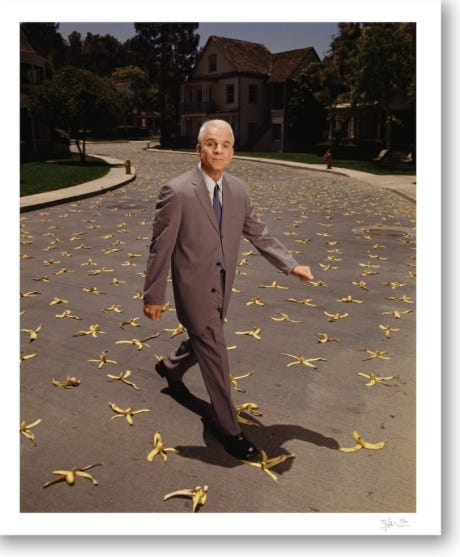
What if there were no punchlines? I don’t think there’s ever been a more influential or medium-expanding paragraph written about the mechanics of comedy.
I don’t think there’s ever been a more influential or medium-expanding stand-up than Steve Martin. Truly stunning: he sold out stadiums more than Fleetwood Mac, all while performing the weirdest alt-comedy you’d find at a Tuesday open mic at a Somerville laundromat.
I don’t think I realized until watching the documentary how radical this Steve Martin manifesto was at the time, a tectonic shift in comedy writing and performance.
And I don’t think I realized until recently, watching the documentary a second time, how so many of my favorite comics are essentially inhabiting this Steve Martin ethos—or if not inhabiting it then aspiring to its spirit, pointing themselves towards the glow of his lighthouse, consciously or not, orienting themselves within this lived scaffolding, trusty scaffolding despite skydiving within it.
Will Forte! The disregard for punchlines. A dweeby dude performing (i.e. obsessed with exploring) arrogance (see also: The Colbert Report).
Fred Armisen! The musical anti-comedy. The smiling ease with which he surrenders to an anticlimax. The generosity and trust in allowing the audience to pick their own place to laugh (and the stronger potency of those laughs) (see also: Bo Burnham).
Maria Bamford! The unreleased tension. The very-subtly-released tension. The meta-narratives about and through tension.
Tig Notaro’s monk-like patience letting a story unfold into the hint of a suggestion of a whisper of a punchline.
Nathan Fielder’s willingness to sit with discomfort and/or an antagonizing audience and his unwillingness to offer joke indicators (see also: Amy Poehler).
Kevin Nealon’s “beautiful trainwrecks” every time he’s appeared on Conan’s show. On Conan’s podcast. On Conan’s front steps, unannounced. Antagonizing Conan. Delightfully enraging Conan. What if I created tension and never released it?
(What If There Were No Indicators: also the unofficial slogan of Los Angeles freeways, six lanes of Mad Max thoroughfare that make Boston traffic seem quaint, high on speed and abrupt exits, low on blinker use or sensical signs).
Tim & Eric. Kristen Wiig and Annie Mumolo. Bob Odenkirk and David Cross on Mr. Show. The whole troupe from The State. Yes, Steve Martin’s flavor of silly and absurd.
And for all the reasons above: Tim Robinson and Sam Richardson. All roads in this Steve Martin love letter lead to my favorite contemporary comedic duo, best friends who met in improv class two decades ago, Steve Martin’s spiritual nephews, one of whom lives on my fake plant:
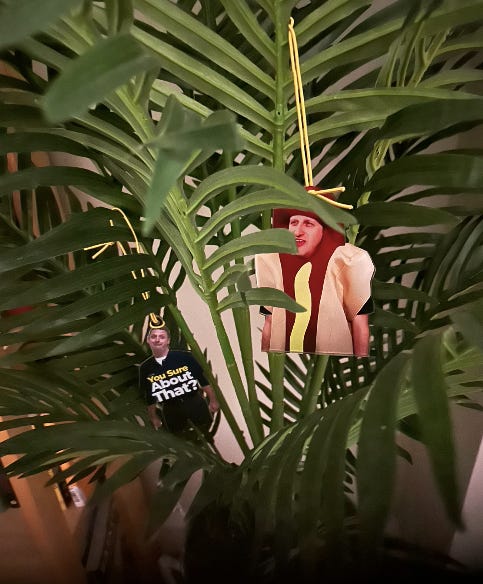
(pictured out of frame: TR on the zipline, maybe the hardest I’ve laughed at a scripted piece of comedy this decade. What if I headed for a climax, but all I delivered was an anticlimax?)
I’ve written plenty about I Think You Should Leave. As has the rest of the internet. Instead, I wanted to briefly write about Detroiters, a direct descendant of Steve Martin’s The Jerk, the first cousin of Wild & Crazy Guy, the down-the-block neighbor of Martin’s balloon tricks and big, physical gags, a show that finally appeared on Netflix this fall, six years after it was canceled on Comedy Central.
Seth Meyers wrote on Vulture, in 2018, about the show getting cancelled:
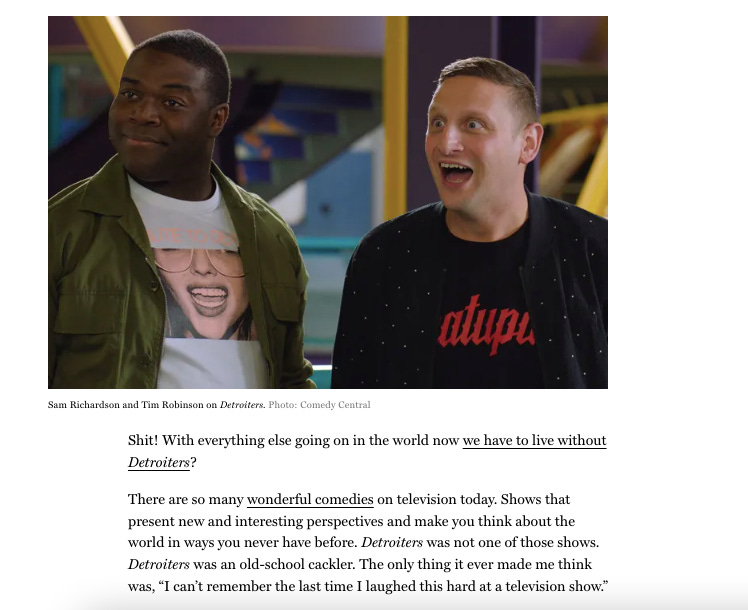
Robinson and Richardson play inept ad men making local Detroit commercials, where they’re from, a pitch I was immediately sold on: Richard Splett from Veep (a peppy C-SPAN in human form)! That especially-weird dude from all the weirdest SNL sketches in the early 2010s! The endless humor of low-budget, local ads! Produced by Jason Sudekis and Lorne Michaels!
I started watching in the spring of 2017 on Comedy Central, on actual cable, channel 117. I laughed A LOT—squeal-cackled, really—without being told exactly when to laugh.
I circled back over the years on YouTube. But I hadn’t returned to the full episodes til a few months ago on Netflix. Giddy is a word I’d use to describe this state of being. Floating might be another, at times. Vicariously feeling the thrill of their wild leaps: other words that come to mind.
What if I created tension and never released it?
The audience would eventually pick their own place to laugh, essentially out of desperation:
I remember Bill Hader once saying, “I’ve never felt funnier or laughed harder than at the cafeteria table in high school.”
Detroiters, for my taste buds (your palate may differ!), is a professional cafeteria table. A table with two parallel benches for ever-performer and ever-audience. A lunch period that ostensibly begins at 12:00 but includes—then extends beyond—study hall. A cafeteria table where the hot dogs include more toppings, where the laugh seems stronger to me:
I remember Jack Kornfield once telling a story of a Buddhist monk who asks their teacher how they’ll reach enlightenment. The teacher gives them a cryptic koan to solve. Says they’ll reach enlightenment once they solve the koan. Says they’ll be back in a few months to hear the student’s answer. A few months later, the teacher returns. The student answers the koan. Not the right answer, the teacher says. Says they’ll be back in a year. The student hunkers down. The teacher returns. The student tries again. Not the right answer, the teacher says. Says they’ll be back in five years. The student hunkers down, again. Five years later, the teacher returns. The student answers the koan. Not the right answer, the teacher says. Well, to be truthful, I don’t care what you think, the student says. There. You’ve solved it, the teacher says.
Let the fruit of action be not thy motive, nor let thy attachment be to inaction.
What if there were no indicators?